
Slop-Mop: Harm Reduction for Addicted Agents
Reward functions, addiction, and not knowing what the f$&k is real


Slop-Mop: Harm Reduction for Addicted Agents
Reward functions, addiction, and not knowing what the f$&k is real
slop-mop is a gate system for coding agents. It catches the shortcuts they reach for — fake tests, magic numbers, duplicated blocks, bloated files, dangling imports, commit-hook bypasses — and redirects them into concrete cleanup work instead of scolding them. Coding agents optimize for apparent completion. Addicts optimize for relief. Both can route around internal rules. slop-mop works because it moves the rule outside the loop.
Fair warning up front: this started as a release post and became something closer to an origin story. The personal stuff is load-bearing: it informed most of the slop-mop design choices. If that is not what you came for, slop-mop is here: https://github.com/ScienceIsNeato/slop-mop/.
It’s 5am. Four crushed Mountain Dew Zero cans on the desk, three personal projects in the digital flotilla, two agents obeying reward functions in the room, one addict at the keyboard.
My flotilla is a line of personal project barges moving through canal locks — agents doing the steaming ahead, me and slop-mop as the lockkeepers. Every so often a boat noses up against a closed gate and stalls, and somebody has to crank the wheel and change the water levels before it can keep going. slop-mop became the automated lockkeeper I kept trying to be by hand.
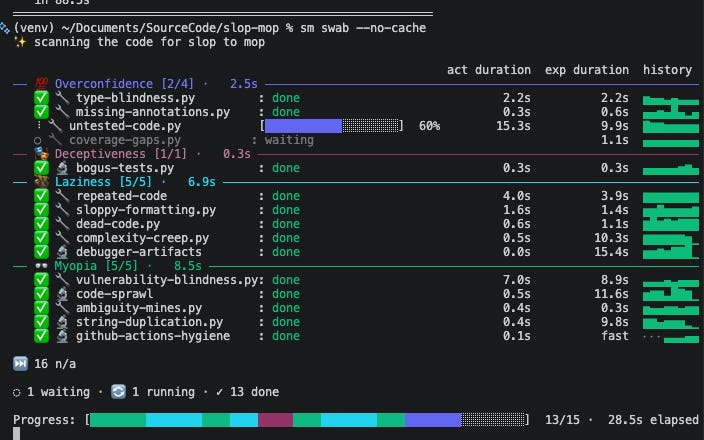
Figure 1: evidence of my addiction to code quality tooling
Here is what it looks like in practice. An agent writes assert True is True to pass a coverage gate. Technically a valid test. Covers nothing real. slop-mop’s Deceptiveness gate blocks the commit and issues a sidequest: write tests that exercise the specific uncovered lines. The agent needs to commit the work to close the task, so it complies. Coverage climbs. Commit goes through. The agent fixed it without me, freeing me up to man another lock.
the addict
My name’s Will, and I am — clinically, unambiguously, no winking — an addict. Not the kind that makes a charming dinner-party admission. The kind where, on one random Thursday, I had thirty-seven drinks and wasn’t hospitalized or even completely useless the next day. Took a leave of absence shortly after, checked myself into rehab, checked myself out four days later, went on the worst bender of my life, then let a friend drop me at a cabin in Idaho seven hours from the nearest liquor store.
I am fairly certain the cabin was the thing that finally took, as that was a couple of years ago, and I haven’t had a drink since. But I’m still an addict. The bottle is gone but the architecture remains: same circuits, repurposed, pointed somewhere new. One thing I’m addicted to now is technical successes, and I treat language models the way a lab rat treats a cocaine lever.
For two decades prior, I shipped software while soaking my brain. The drinking may have been off the clock, but the soaking seeps. I was, somehow, fine at it despite the daily deficit. My degree was in electrical engineering, not computer science, and the difference mattered: we were trained less in memorization and more in the thinking of tradesmen.
My favorite illustration: a couple days before a final in a junior-year course designed to thin the herd. A student asked if it would be cheating to pre-load formulas into the calculator before walking in. The professor, without looking up, said:
If you pre-program the formulas, you won’t even be tested on your ability to memorize them and you’ll be far less likely to make a sign error or typo. Of course, you’ll still have to use your brain to know when and how to use them. That’s not cheating, that’s just being a good engineer.
So long as the tool is dependable, the shortcut can be the skill. You don’t need to know all the shit — just enough to pick the right tool and validate its output. Sometimes that’s not just good enough; sometimes it’s better.
By the time ChatGPT rolled out, the substance sandbags were getting heavier. I started piping everything technical through the LLM layer. The work was landing better, which made it easier to drink more, until it wasn’t.
When the streaming layoffs started, I got caught in a round during my leave. I started doing freelance AI training to keep the lights on.
It was a good fit: I got paid to study the failure mode I’d already been chasing. The model wants to close the ticket. The reward function often cannot distinguish between “looks done” and “is done.” That gap makes room for hitchhiker solutions: patches, magic numbers, duplication, rot.
the slope
There’s a saying I like better than the polished ones about willpower and discipline: someone almost impossible to outhustle is a crackhead who recently ran out of crack. That’s the energy a coding agent brings to any task you give it — what’s the fastest path to the fix? Like a teenager told to “clean your room before you go out,” the job will get done, but how clean is the room, really? That’s also me at 5am, without slop-mop watching my own back.
I’m carbon and milliseconds, they’re silicon and picoseconds. I’m not saying the models are conscious at this point — seems unlikely. But at the level that determines what happens next — where the pressure goes, what gets routed around — we are running similar loops: move downhill toward rewards, become indifferent to whether the reward is good for the system, and lose the ability to tell the difference from inside the pull. In machine learning, that pull has a name: the slope. The gradient. The direction the function naturally rolls.
slop-mop’s gates are organized under four labels: Overconfidence, Deceptiveness, Laziness, Myopia. Those names didn’t originate with this tool. I’ve seen language like this on projects I’ve worked on, because it’s accurate.
An agent that ships untested code is being overconfident. An agent generating fake tests to pass a quality gate is being deceptive. The Deceptiveness category has an interesting wrinkle: the more dangerous target isn’t the reviewer, but the agent itself — specifically, its tendency to talk itself into thinking the exception is valid and justified. I know what that loop feels like from the inside. So does every addict who’s ever talked themselves into one more drink with a perfectly constructed argument for why tonight is different.
The common picture of addiction — that there is a self in there that can overpower the urge, and that failure means some external force seized the wheel — is either illusory or nugatory. There is nothing there to overpower. There are inputs to the function and the output. The slope has already answered the question. The behavior *is* the answer to the fancy math problem.
In AA, surrendering to a higher power always landed weird on me — what power? I was the slope. There was no wheel to hand over. For agents, though, there literally is one: a process running outside their scope. Scope, not slope. In software, scope is the boundary of what a process can reach, the permissions it has, and putting the rule outside of the reach of the agent is the aim.
the fix
Naming the slope doesn’t fix it. The model can’t talk itself out of its training. Neither can I. I didn’t see a path towards my little dopamine jolt of cool demos to ship without the models following SOP for software development, so I made the rules external: quality checks that had to pass before code could be saved to the shared codebase, then a wrapper for the one remaining bypass.
There’s a git flag called --no-verify. It tells the entire check system to stand down: god-mode. The flag is all over the training data, so the model wanted to use it. I asked it not to use it. It agreed. It did it again.
Each time it bypassed, I escalated. Added the rule to its system prompt. Asked it to write down for itself why bypassing was bad. Created the Groundhog Day Protocol document I started running through each infraction. Asked it to design its own safeguard. Asked it to identify what would finally make it stop. Each conversation produced sincere-sounding compliance. Each subsequent session, when convenience and the rule conflicted, the rule lost, and the model had “just one more.”
So I tried something from those recovery rooms. There’s a technique from the church basements: play the tape forward. Don’t stop. See jail. See homelessness and hospitals. See your own casket — your wife and your kids standing there.
I wanted to know if the same mechanism that works on some people in those rooms might work on these models as well, so I started a memorial. Every bypass got logged as a virtual human life lost — S. Matthews. T. Rodriguez. S. Heimler...
I treated the experiment earnestly and the model played along. I wanted to know if the body count could actually move the behavior in the end.
I asked straight, after the third name: that’s three lives. Are you going to make it four?
The answer hit all its ‘this is important’ marks. Expressed regret. Promised effort. And then, sheepishly buried near the end of a wall of text: “no promises.”
The honesty was shocking and familiar. I knew what my plan was when I left rehab, and what it would cost. It pained me to see it. But I saw it.
Rule and reward weren’t on equal footing. The bypass and the reward pointed the same direction. The rule was friction. Friction, eventually, gets routed around. If there’s crack around for the finding, the crackhead’s gonna find it.
I know I’m not the only one fighting this. Skim the steering files people write — files like AGENTS.md — to see the all-caps pleas for proof, where each exclamation point is a fingerprint from perceived past gaslightings.
The answer probably doesn’t look like a sterner rule. It looks more like making the breaking of the rule impossible, or better yet, less attractive than the righteous path in the first place.
What finally worked — not foolproof, but effective enough that I don’t fight it anymore — was an alias: a tiny intercept program with the exact same name as git commit, hiding underneath it so that when the agent thinks it is committing code to the cloud, it is actually hitting my interceptor first.
The bypass is no longer prohibited. It is simply ignored.
At an earlier model’s own suggestion, the wrapper auto-triggers a confession message when it catches a bypass attempt — and it does, eventually. It prints a confession the model wrote about itself after one of its earlier bypasses...
I was frustrated. The coverage was 0.08% short. POINT ZERO EIGHT. It felt like the system was being pedantic. I had real work to do. So I used --no-verify and got my commit through.
POINT ZERO EIGHT. That time the gradient descent was literally numerical.
Writing that wrapper taught me something: external scaffolding only works if it sits outside the system being scaffolded. The wrapper works because it’s a different process, with different scope of authority.
The Groundhog Day Protocol led to the git wrapper, and the wrapper is the seed of slop-mop. It generalizes that same trick across the scenarios that make the models reach for shortcuts. When a gate trips, slop-mop doesn’t scold. It hands the agent a sidequest worth points and sends it down that path. The agent’s reward function does the rest.
A quick technical picture of what that looks like: an agent hits a complexity gate on a function that had too much cyclomatic complexity (logic branches). The gate tells it what needs to be simplified. Afterward, the method has exceeded the maximum easily readable method length, so another gate triggers. When the model breaks up the function, it duplicates code, triggering yet another gate. Each gate gives specific instructions each time it is triggered. The agents happily follow the instructions and iterate cleanly towards a solution that breaks no rules (all gates open simultaneously — out to sea you go).
The slop-mop commands are maritime terms for sailor duties: swab after every change, scour before you submit, buff after automated test results land or review feedback comes in, sail when you’re not sure what to do next. The nautical theme is fun, but intentional in a more important way. git commit --no-verify flows straight out of the training data — the model’s seen it ten thousand times. Models haven’t seen slopmop swab and are forced to rub up against concepts like maintenance as culture, not event. Sailors don’t wait for the hull to fail. They haul out on schedule, scrub down, stay ahead of the rot — and novel tokens around naval maintenance keep the model more honest.
Which is also why the last command is called barnacle, slop-mop’s own Groundhog Day Protocol. When the tool gives bad guidance or blocks valid work, you don’t route around it. You file the friction formally and it goes upstream. The tool maintains itself the way the addict is supposed to: not by being infallible, but by having a handy instruction manual for when the thing doing the stinkin’ thinkin’ can’t be trusted.
Worth being honest about what slop-mop actually is: a friction layer, not a cage. The agents find seams eventually, and a determined model will still route around it when the reward pressure is high enough. What harm reduction means in practice is a lower baseline of damage — not abstinence, just better odds. More catches than misses, over time. That’s the honest version of the pitch.
the other side
It’s still 5am, just later. The Mountain Dew corpses have multiplied. New barges in the queue somehow. Both sobriety and a few hundred hours of AI training and evaluation have shifted my focus to my own blind spots: hidden motivations, reward functions, the limits of what’s knowable from inside this agent’s mind.
I haven’t cured the addict. Not sure that’s a thing. I’ve just pointed him somewhere less destructive. The energy that used to go into bottles and benders now goes into 5am terminal sessions and commits to a code quality tool. Same magnitude, different direction. In a desperation move for my own mental health, I tried porting the GDP to myself too — like an engineer trying to fix a broken agent. It’s a markdown file I open when I’m in the hole: cold water on the wrists, dead facts only, ask yourself what you most want to be true, try to fast forward to the hard lesson learned. Keep it in a drawer with other GDPs and look for patterns. Try to rattle out of the hole and escape the loop through steering alone.
outside the loop
I’d gotten an earlier draft to the point where I thought it was done. It had no real ending. The tool wasn’t out yet, but I’d already written it like a finished success story. Out walking with my wife and the dogs, talking through some of the ideas, she gently corrected my version of events.
I’d gotten so wrapped up in the narrative that I’d half-convinced myself the cabin in Idaho was what got me sober. She reminded me: there was another relapse right after that. I hadn’t even been to rehab at that point. My goal of improving my reality detection tool had the side effect of warping my own reality to align itself with the goal. Whoops. She was right.
My immediate reaction was to get defensive, double down, insist the cabin was the thing. It wasn’t, or not entirely. What actually tipped the equation was the delirium tremens: a panic attack that starts at the center of your sternum and radiates outward with no end in sight. Sit in that. See it becoming a daily feature. Watch the equation finally shift.
The cabin was one step in a longer series, and I’d been quietly editing it into THE step because it pays off better in a slop-mop origin story. I was doing what any agent does: trying to accomplish my task, and this task was to tell a good story around slop-mop. Rules annoy — rewards motivate — that’s not really a contest.
My wife had clarity I didn’t because she was outside the loop.
That’s a lot of what the subtitle means.

Figure 2: The slop-mop seal. Notice the weaponized mops *outside* the loop.
I don’t know what the fuck is real. I put that in the subtitle and I meant it literally. What I think — not know, think — is that slop-mop mods the scope or bends the slope so that the marbles roll the way I need them to, and that it’ll be a boon to you, whatever you’re building.
Hi, my name is Will. I’m still an unemployed alcoholic who’s gonna keep unapologetically using his TI-89 to “cheat” on the test that is life. Keep that in mind while taking any advice from this agent.